
What's really blocking UK advice firms
The Frankenstack: a monster of our own creation

Mike Hearfield
21 Jul 2026

Ask a roomful of UK advisers what's slowing them down, and you'll get list that's probably familiar:
- AI is moving too fast,
- clients don't understand plans,
- data integration across tools is a joke,
- we're still re-keying data from spreadsheets,
- there's too much choice and not enough benefit from tech.
Those answers sound like five different problems but they aren't - they're five symptoms of the same underlying problem.
Our research shows two big, and 6 small key issues
We've been pulling together observations from across UK adviser communities - forums, vendor reviews, professional conversations - and clustering what firms complain about. The picture is consistent.
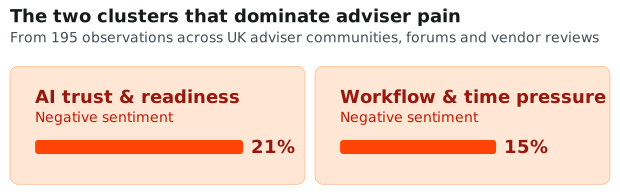
The two biggest pools of pain by volume are AI trust and readiness and workflow and time pressure. Together they account for around a third of everything we logged, and both carry 'mild' negative sentiment, which suggests it's an ongoing pain rather than a sudden change.
Looking further, there's integration friction, which, interestingly swings positive when firms talk about it working. It's that rare case where the thing being complained about is fixable, and people know it.
The most negative sentiment, though, sits in the smaller clusters: the planning vs illustration gap, tool sprawl and stack fatigue, change and migration pain, and defensibility and compliance anxiety.
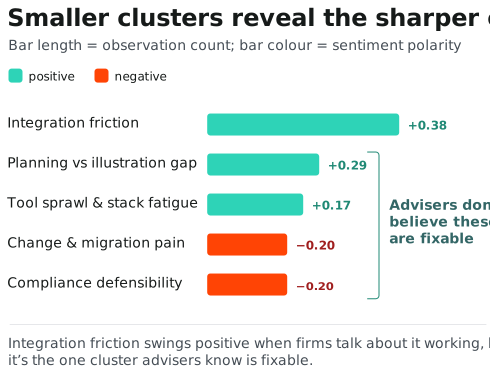
These aren't the loudest complaints, but they're the ones advisers talk about with real frustration, and they seem to be the ones that most people think cannot be solved.
What jumped out to us, though, was what these clusters have in common. They're not really about features - they're about the gaps between things - the gaps between systems, between data, between what the firm captured at fact-find and what the engine needs at recommendation, between what compliance saw and what the client actually did.
Every cluster traces back to the same root cause.
The monster in the corner
That root cause is the tangle of systems most firms are built on, and we've started calling it the Frankenstack.
Most UK advice firms didn't set out to build one. They built it the way Frankenstein built his monster - one well-intentioned part at a time. A CRM bought because the old one wouldn't scale. A planning tool added because the CRM's modelling was thin. A portal bolted on because clients expected one. A meeting-notes AI because the regulator started asking for evidence of suitability. A cashflow tool because the planning tool's outputs didn't quite fit the conversation. An integration layer, then a second one, then a spreadsheet to make them talk to each other.
Every purchase was rational - each promised cheaper, better, faster and none of them were wrong on their own terms.
But, unless a firm can go all-in on a single unified four-stack vendor - and frankly there aren't many - they end up shopping the market for the bits that their main supplier missed.
And, so, the monster grows.
It lumbers around the firm trampling efficiencies and traumatising users - it creates the data-quality, integration, and workflow problems that research keeps surfacing.
The four layers that (almost) nobody owns end-to-end
The reason the Frankenstack feels so unfixable is that advice software must do four very different things, and they sit on top of each other:
- Understand: capture what's true about the client: their numbers, their goals, their behaviour, their context.
- Explain: translate that understanding into something a human (client, adviser, or regulator) can act on.
- Decide: work out what the right next step is, deterministically, with tax and sequencing logic that's defensible.
- Act: execute on that decision: trigger the journey, run the workflow, complete the transaction, evidence it for compliance.

Most stacks do Understand and Explain reasonably well, but most are weak at Decide and almost none of them genuinely Act.
The Frankenstack you're working in is, more often than not, a collection of Understand-and-Explain tools that hand off to humans for the bits that matter most.
That's why advisers feel busy but not productive - the kit captures and reports; the people decide and act.
The two viable ways out
There are only two ways to banish a Frankenstack.
The first is to migrate to a true four-layer platform - one vendor, one client model, one decision layer, one engagement layer, one audit trail. It works, and it sets you up for long term success by giving you a structured business with demonstrable re-sale value, but it's not an instant fix.
Even if you find a supplier that's excellent at migration, you will need to retrain everyone, take a disruption hit, and work with the vendor to stay ahead of the market across all four layers.
The second is to organise the Frankenstack with a wrapper built on a four-layer data model. Keep the kit your firm has chosen and put an intelligence layer across it. Have that layer own the structured client model, the decision engine, and the action framework, and let your existing tools carry on doing what they're good at. No rip-and-replace. No retraining everyone. The monster stays, but it stays in its box.
The Advice Management software at the heart of Focus is built this way: a four-layer data model designed to organise what's already there, decide what should happen next, and drive the action through to outcome.
If your firm is wrestling with a Frankenstack of its own, you're thinking about how to evidence value ahead of an exit sale, or you're wondering about acquiring a new firm, we'd be happy to show you what either approach looks like in practice - drop us a line at hello@focusadvice.tech and we'll set something up.
Who are Focus?
Focus Business Solutions — trading as Focus Advice Technology — builds advice technology for the firms doing the work. We make financial advice cheaper to deliver, easier for clients to understand, and harder to get wrong. Independent, UK-based, with a 30+-year track record and long-running partnerships with firms like NFU Mutual, Skipton Building Society, Santander and abrdn.
Our digital products set covers the full advice lifecycle — digital client engagement, advice delivery, API-accessible financial planning tools and engines, and the Advice Engine: a deterministic investment-advice engine that optimises product and portfolio recommendations against your firm's defined process.
The result is multi-channel automated advice solutions that make financial advice delivery more efficient and more engaging for advice firms and their customers — driving better consumer outcomes for UK financial advice firms.


